 MyRecover



How to Recover Deleted Photos from Keepsafe | 5 Easy Ways
This guide provides a complete walkthrough on how to recover deleted photos from Keepsafe using official methods. If you lack a subscription, we explain how to recover deleted photos from Keepsafe without premium by utilizing the Recently Deleted folder before it expires. We also cover accessing cloud backups and troubleshooting common issues to ensure you successfully restore your precious memories.

By Delores / Updated on March 4, 2026


What is Keepsafe?
Keepsafe is a privacy-focused mobile application, often described as a "photo locker" or "vault" that secures personal photos and videos on your device by allowing you to hide sensitive images from anyone who might access your phone.
To ensure this protection, Keepsafe employs several security layers, including PIN or biometric access controls, military-grade AES-256 encryption, and a privacy-by-design approach, ensuring no Keepsafe employees can ever access your content. The app offers free basic features alongside a Premium subscription that unlocks individual album locks, an ad-free experience, and trash recovery capabilities.
If you deleted the Keepsafe photos and videos by accident, don't worry. We will show you everything about it and provide effective solutions to recover deleted photos from Keepsafe.
What Happens If You Delete Keepsafe Photos?
When you remove a photo from your Keepsafe vault, it doesn't vanish immediately—it gets sent to the Trash folder instead. Restoring those deleted items requires a Keepsafe Premium subscription. If you empty the Trash or manually delete items from it, those photos are gone for good with no way to bring them back. One more thing to keep in mind—everything sitting in your Trash still counts toward your cloud storage limit, so it's not truly "free" space until permanently deleted.
Where Does Keepsafe Store Photos?
On Android devices, Keepsafe stores your photos in a hidden folder named .keepsafe located in your device's root directory, typically found at paths like mnt/sdcard, storage/emulate/0, or similar variations depending on your device manufacturer. The leading dot marks it as hidden from standard gallery apps and casual users, though the files themselves remain encrypted and inaccessible without the app's authentication. Keepsafe requires storage permission specifically to maintain this dedicated, protected space that other applications cannot penetrate.
On iOS devices, the storage situation is fundamentally different due to Apple's sandboxing architecture. You cannot directly access Keepsafe's storage folder through any standard file browsing method—the app stores your protected photos within its own secure, sandboxed container that's completely isolated from the rest of the system. The actual encrypted files reside in an app-specific directory that remains inaccessible to users and other applications by design, requiring permissions for photo library access, camera capture, and biometric authentication to maintain this walled-off security approach.
How to Recover Deleted Photos from Keepsafe?
Important: Stop using the Keepsafe app right now. When you delete photos in Keepsafe, the application does not immediately erase them from your device's storage. Instead, it designates that storage space as available for new data to overwrite. Keep using it might overwrite the original deleted data.
Way 1. Check Your Internet Connection and Sync Status
Before assuming permanent data loss, verify whether a synchronization issue is causing your photos to appear missing. Keepsafe maintains continuous communication with its cloud servers, and interruptions from unstable Wi-Fi, unreliable cellular connections, or temporary server problems can prevent your albums from displaying correctly.
Toggle your Wi-Fi connection off and on, confirm you have stable internet access, and allow the app sufficient time to resynchronize. Your photos may reappear automatically once proper connectivity is restored, eliminating the need for further recovery efforts.
Way 2. Recover Deleted Photos from The Keepsafe Trash Folder
You can restore deleted photos from the Keepsafe Trash folder within 30 days after deletion if you have the Keepsafe Premium subscription.
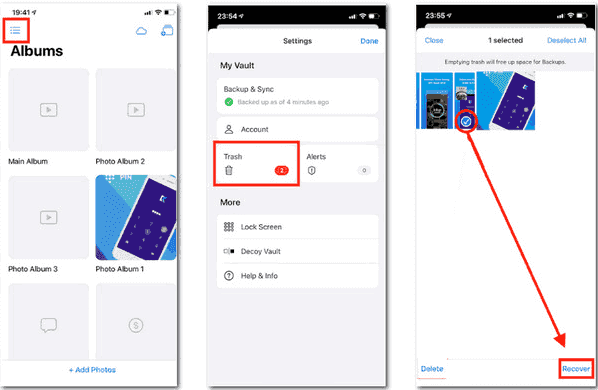
For iPhone users:
1. Fire up the Keepsafe app and tap that Settings button in the top-left corner.
2. Scroll down until you spot the Trash section.
3. Tap to select individual photos and hit that Recover button to restore deleted Keepsafe photos now.
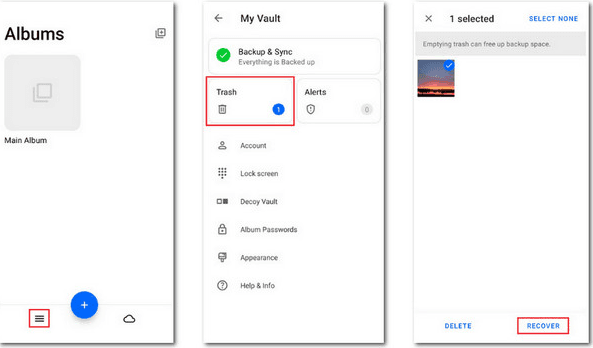
Android users, your journey is similar but with a slight twist:
1. Tap the Settings button in the bottom-left corner instead, then navigate to Trash.
2. Find recently deleted items, complete with thumbnails and deletion dates.
3. Select the photos and tap Recover.
Way 3. Get Back Deleted Keepsafe Photos from Keepsafe Cloud Backup
If you've enabled Keepsafe's cloud backup feature, your photos might be stored in the cloud, ready to download. To check if you have enabled cloud backup, dive into your Keepsafe Settings and look for the Private Cloud or Backup section. If the toggle is green, you have enabled it, or it's not.
1. Open up your computer, head to the Keepsafe website, and log in using the same credentials you use on your phone.
2. You'll see your albums laid out in a familiar grid. If you find your missing photos in the cloud version, try to sync them to your phone.
3. On your mobile device, open the Keepsafe app and pull down on the screen to force a manual refresh. The app should reach out to the cloud servers and download any photos that are present there but missing locally.
4. If that doesn't work automatically, try signing out of your account and signing back in. This often triggers a full sync that pulls down everything associated with your profile.
Way 4. Recover Deleted Keepsafe Photos Without Premium Access
Keepsafe, like many freemium apps, gates certain features behind a paywall, such as recovering from the Trash folder or cloud backup, etc. Free users can see the Trash folder, but attempting to restore anything will trigger an upgrade prompt.
Additionally, cloud backup features are often limited or unavailable for free accounts, meaning that even if your photos are technically backed up, you might can't download them.
Thus, screenshotting each photo individually is a tedious but technically free option. Or, if you're technically inclined, you might explore whether your device's file system still holds cached copies of those images before they're permanently overwritten.
Way 5. Contact Keepsafe Support for Advanced Recovery Help
When all else fails, it's time to call in the cavalry. Keepsafe's support team has access to backend systems that regular users don't.
Shoot an email to [email protected] or visit their support page to submit a request.
Be prepared to provide details: when the photos were deleted, what device you're using, whether you had cloud backup enabled, and any troubleshooting steps you've already tried.
The more information you give, the better their chances of helping. Response times vary, but many users report success stories after reaching out directly.
Fix The Keepsafe App Crashes and Login Issues
If the Keepsafe app keeps crashing every time you try to access settings or the trash folder, you might be dealing with a corrupted app installation.
The fix? Uninstall the app completely, restart your phone (this clears temporary junk files), and then download a fresh copy from the App Store or Google Play Store. Log back in with your credentials, and chances are good that your sync issues will resolve themselves.
Best Practices for Securing Your Keepsafe Vault
Enable Automatic Cloud Backups
Seriously, do this right now. Open your Keepsafe settings, find the Private Cloud or Backup section, and toggle that switch to “On”. With automatic backups enabled, your photos will continuously sync to Keepsafe's secure servers. You can download them anytime.
Regularly Export Your Vault to External Storage
Every few months, take ten minutes to export your entire Keepsafe vault to your computer's hard drive or an external SSD. Use the app's export feature to transfer photos to your camera roll, then copy them to your computer.
FAQs About Keepsafe Photo Recovery
How do I recover deleted Keepsafe photos without a premium?
A: Free users have options. Check if photos appear in the Trash folder—visibility confirms they exist. Screenshot visible Trash thumbnails before they expire.
If I delete the Keepsafe app, will it delete my pictures?
It depends on your backup status. Photos synced to Keepsafe's Private Cloud remain safely on their servers and restore automatically when you reinstall and log back in. However, photos stored only locally on your device will be permanently lost during uninstallation. Check your backup status: photos with a crown icon are cloud-synced and safe; photos with a white circle are local-only and need backing up before deleting the app.
Where are Keepsafe photos stored on my phone?
A: Keepsafe stores photos in encrypted folders typically located in your device's root directory—paths like storage/emulate/0, mnt/sdcard, or mnt/flash. These folders are hidden from regular file managers, which is why gallery apps can't see them. Recovery tools need special permissions to access these protected areas.
If I delete the Keepsafe app, will I lose my photos?
A: Not if you had Private Cloud backup enabled. Your photos remain safely on Keepsafe's servers and will sync back after reinstalling and logging in. Without cloud backup enabled, locally stored photos may be lost unless you recover them through third-party tools before data gets overwritten.
How do I recover photos from the Keepsafe cloud to a new phone?
A: Download Keepsafe on your new device and log in with your original credentials. Give the app time to sync—manually trigger it by pulling down on the albums screen or restarting the app. All cloud-backed photos should appear within minutes if backup was enabled on your previous device.
Recover Deleted Files on Windows If Necessary
If you have backed up Keepsafe data on your Windows computer, and they get lost somehow. What should you do? You can try the powerful Windows data recovery software MyRecover to recover the deleted Keepsafe photos and videos, especially when they've been permanently erased from the Trash folder.
MyRecover digs deep into your device's storage at the file system level, scanning for data that hasn't yet been overwritten. MyRecover goes straight to the source—the actual storage sectors where your photo data resides.
It supports a wide range of image formats, including JPEG, PNG, and others, and it prioritizes data security throughout the recovery process.
Step-by-Step Guide to Using MyRecover for Deleted Keepsafe Photos
1. Please download and install MyRecover on your computer, instead of the drive you’re recovering files from.
 100% Secure
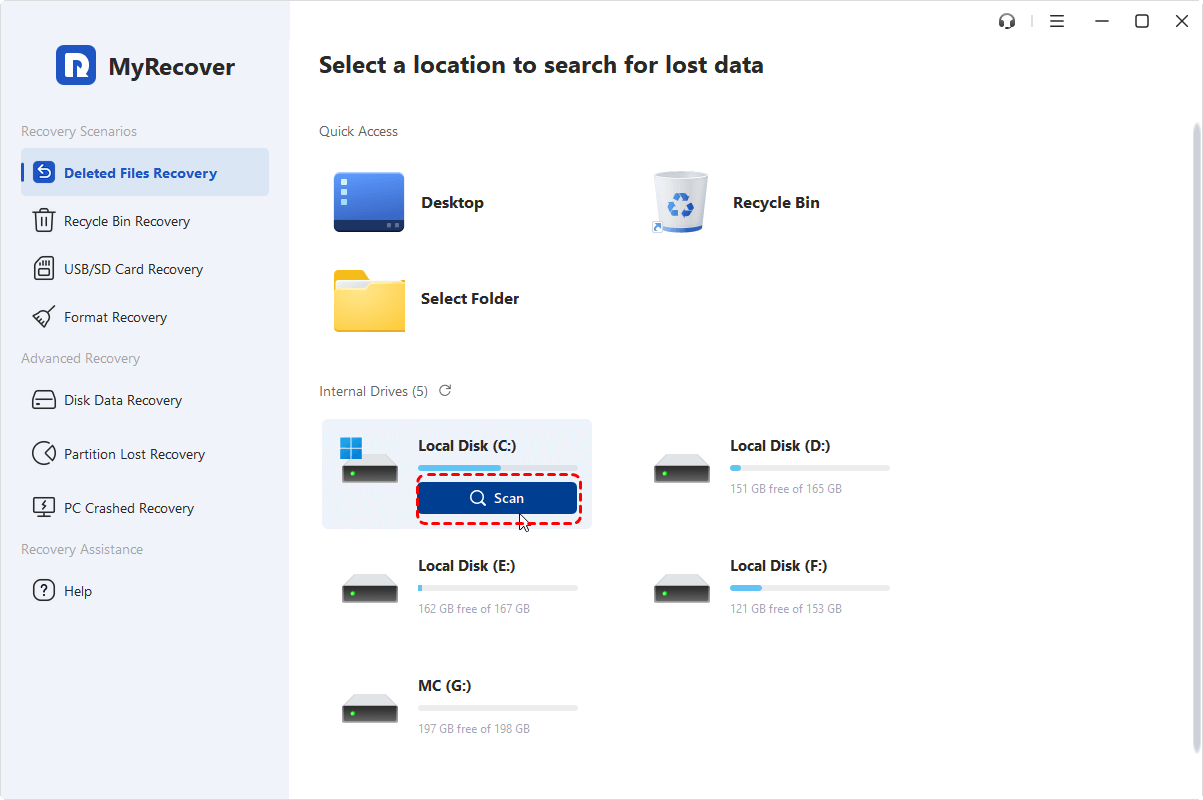
2. Tap Deleted Files Recovery, choose the drive where the Keepsafe backup data was located before, and hit Scan. Hit OK when it’s done.
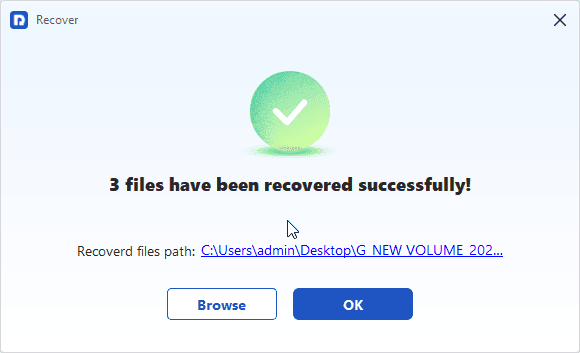
3. Double-click to preview the photos you need, tick them, and tap Recover.
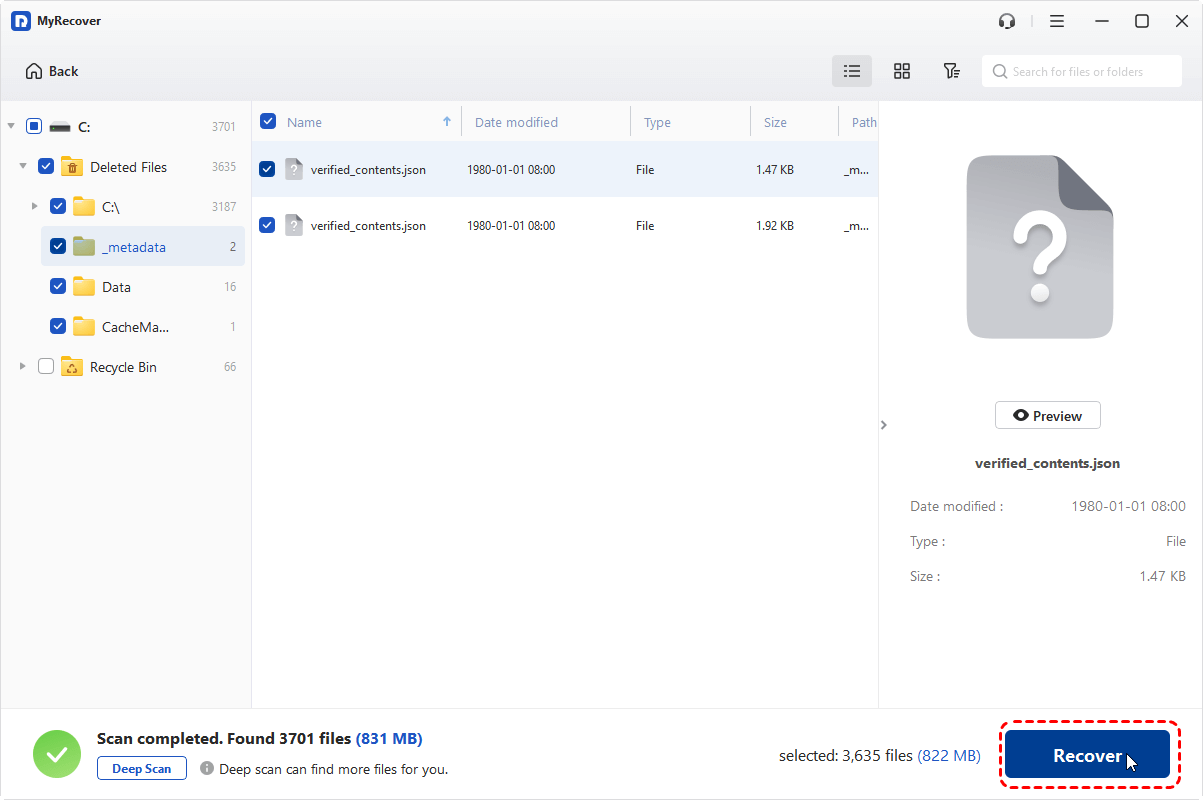
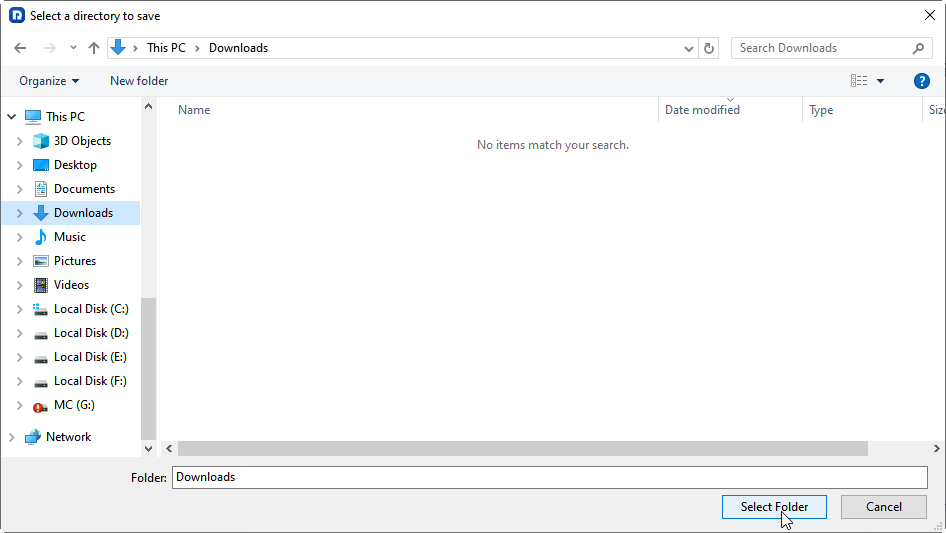
4. Select a safe location to keep them.
- Notes:✎...
- By default, these deleted files will be sorted by type, like documents, music, videos, audios, etc. You can tap Path to show them by folder structure. Meanwhile, you can filter files by file extensions, names, size, and modified date, etc.
- You can also upgrade to MyRecover Technician to recover files from unlimited computers if you’re an administrator.

 MyRecover
- Recover Deleted Files Easily with Simple Clicks
- 1000+ File Formats Supported
- Support HDD, SSD, External Hard Drive, USB Drive, SD Card, etc.
- Quickly Find Files Using File Types, Name, Size, etc.
- Preview Files Before Recovering
- Recover Unlimited Data
 100% Secure

Stay Updated With Our
Latest Tips
Add us as a preferred source on Google to never miss helpful guides.
 Add as preferred source >>