 MyRecover



Recover Data from Deleted Partition in Windows 10 /11 in 2 Ways
Accidentally deleted a partition or volume? Discover how to recover data from deleted partitions in Windows 10 with free, reliable software. Our guide covers proven methods to restore files from deleted, formatted, RAW, or lost partitions, even if you’re not tech-savvy.

By Delores / Updated on September 9, 2026


User Case: Can I Recover Data from Deleted Partition?
How to recover data from a deleted partition in Windows 11 for free?
My external drive is not showing up correctly in Windows 11 File Explorer, and it reminds me to format the drive before using it. In fact, the computer has one internal SSD and hard drive. I deleted the wrong partition in the Disk Management utility. How can I recover data from a deleted partition in Windows 11? I don't want to lose the data. Thanks
- Question from techcommunity.microsoft.com
Recovering a lost partition - need advice on program/utility to do so
Hi all,
I had a hard drive that was partitioned like this (neither is an OS, just NTFS partitions for storing data):
U: 750 GB Z: ~2.9 TB (or whatever, it's a 4 TB drive)
I emptied out U: and then wanted to expand Z: to fill the space. I set this running in my usual program for meddling with partitions (EaseUS Partition Master), and unfortunately it crashed partway through the process. My system still recognises the physical drive (and the fact it's meant to be Z:); however, Windows can't see any partitions and won't mount it. Most of the programs that surfaced in a quick search either couldn't help or were definitely reporting statistics falsely.
Any advice or recommended software to try to recover the data from Z:?
- Question from reddit.com
Deleted a partition from your hard drive by accident, just like the above users? In most cases, the data is still on the drive—deleting a partition removes its address, not the files themselves. So, don't worry; you can find easy ways to recover data from a deleted partition in this post. This guide shows you exactly how to get them back, step by step, with the free and paid tools that actually work.
Immediate Actions to Take Before Troubleshooting
Stop using the disk before anything else in case data is overwritten.
Do:
- Power down or disconnect the affected drive as soon as you notice the mistake.
- If it's an external drive, unplug it and connect it to a different healthy computer for recovery.
Don't:
- Don't create a "New Simple Volume" in Disk Management on the unallocated space.
- Don't format, run chkdsk, or install programs onto the affected disk.
- Don't defragment or run repair tools on it—any write can overwrite your lost data permanently.
Can You Recover Data from a Deleted Partition? Fast Answer!
Almost always, yes—if you act before the space is overwritten. When you delete a volume by clicking "Delete Partition" or "Delete Volume" in Disk Management, Windows only removes the partition's entry from the partition table. The file system (NTFS, FAT32, exFAT) that describes your folders and files is no longer "mounted"; the space is marked as "unallocated". So, File Explorer can't show the drive. But the bytes that make up your documents, photos, and videos are still sitting on the platter or NAND chips until something new is written there.
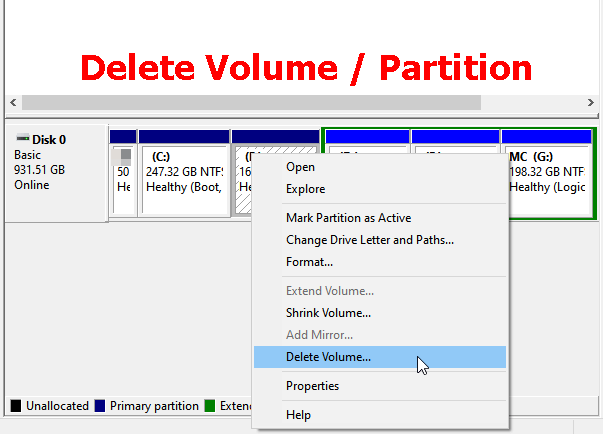
This is why the drive now shows as "unallocated" in your disk management: the space is marked free, not erased. Specialized recovery software can re-read the raw sectors, find the old file tables (or file signatures), and bring your data back.
- Notes:✎...
- MBR vs GPT: An MBR disk stores one partition table at the start of the disk; a GPT disk stores multiple redundant copies. Deleting a partition edits this table—not the data area.
- VBR (Volume Boot Record): Each partition has a boot sector describing its file system. Recovery tools scan for these signatures to locate lost partitions.
- On a traditional HDD, deleted-partition recovery is usually highly successful if you stop promptly. On an SSD, the TRIM command tells the controller to erase freed blocks in the background. Once TRIM executes (often within minutes of deletion, or at the next idle period), the data is typically gone for good. If the deleted partition was on an SSD, run a recovery scan immediately and expect lower success rates than on an HDD.
After that, the solutions are different due to your needs. Are you recovering files from the deleted partitions, or do you want all the deleted partitions and their files back?
How to Recover Data from Deleted Partition or Volume in Windows 10 or 11?
First of all, we will show you how to recover files from a deleted partition in Windows 11/10. Let's find out more.
Recover Files from Deleted Partition with MyRecover (File-Level)
As the best Windows data recovery software, MyRecover scans the lost partition, lists recoverable files with their original names and folders when possible, and lets you restore them to a healthy drive.
Enjoy MyRecover Benefits Now:
- High Success Rate with Advanced Scans: It uses Deep Scan technology, which performs a thorough, sector-by-sector search to find files even on formatted, corrupted, or severely damaged partitions, giving it a high recovery rate for lost data. It also provides a quick scan to find recently deleted files.
- Simple, No-Command-Line Interface: Designed for all users, it features a clean Graphical User Interface (GUI) that guides you through a simple Select, Scan, and Recover process, requiring no technical expertise.
- Preview Before Recovery: You can preview files(such as photos, documents, and videos) before restoring them, helping you select the correct files and save time.
- Safe, Read-Only Operation: The software operates in read-only mode, meaning it scans your drive without writing any new data. This is crucial as it prevents overwriting the very files you're trying to recover.
- Broad File System & Device Support: It supports recovery from NTFS, FAT32, exFAT, and ReFS drives and is compatible with over 500 devices, including HDDs, SSDs, USB flash drives, and SD cards, making it versatile for both internal and external storage.
- Extensive File Format Support: Recovers over 1,000 file types, including documents (e.g., PDF, DOCX), photos (e.g., JPG, RAW), videos (e.g., MP4, MOV), audio, and archives.
- Comprehensive Compatibility: Works seamlessly with Windows 11, 10, 8.1, 8, 7, Vista, XP, as well as Windows Server systems.
4 Steps to Recover Files from Deleted Partition in Windows 11/10
Here is the complete guide on how to recover data from a deleted volume via free software - MyRecover- step by step. Let’s explore now.
Step 1. Install and run MyRecover on your Windows computer. Then launch it.
 100% Secure
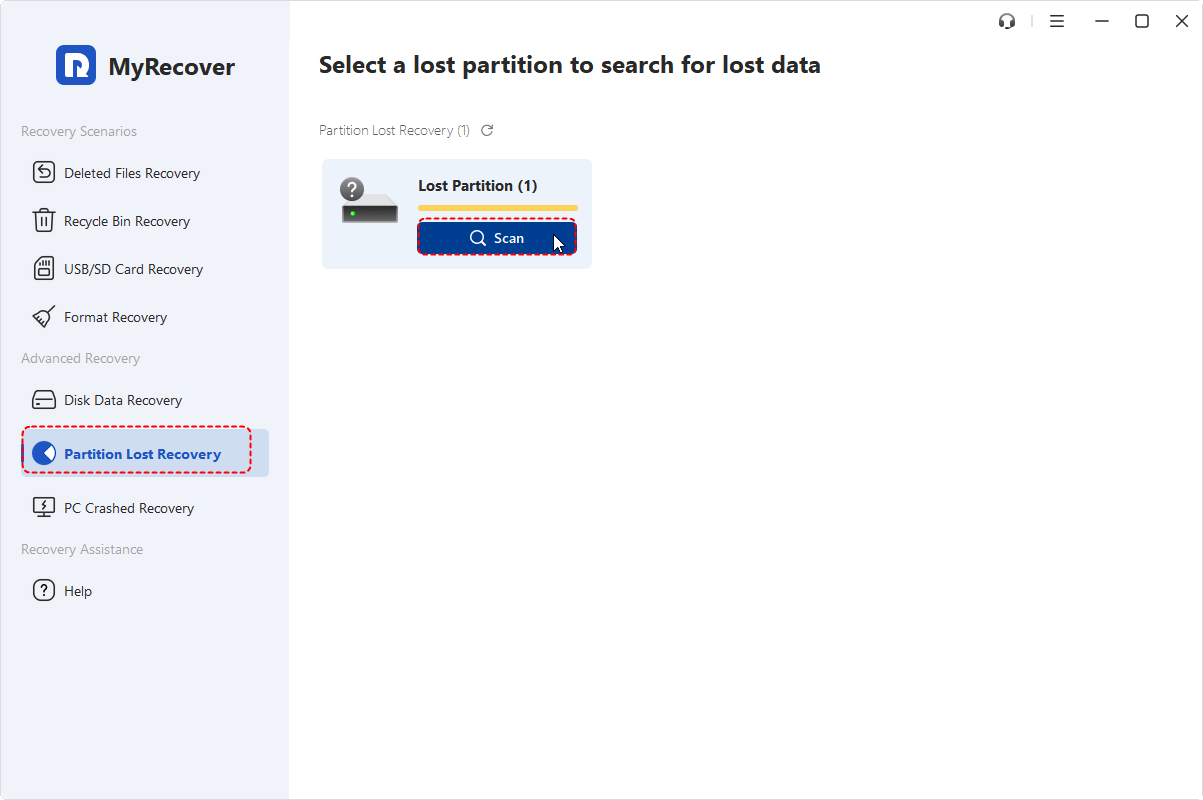
Step 2. Click "Partition Lost Recovery" under the "Advanced Recovery" section. It will automatically list all the deleted partitions. Hover over the deleted partition you need to recover (identify it via the partition size), then click "Scan" to start a deep scan.
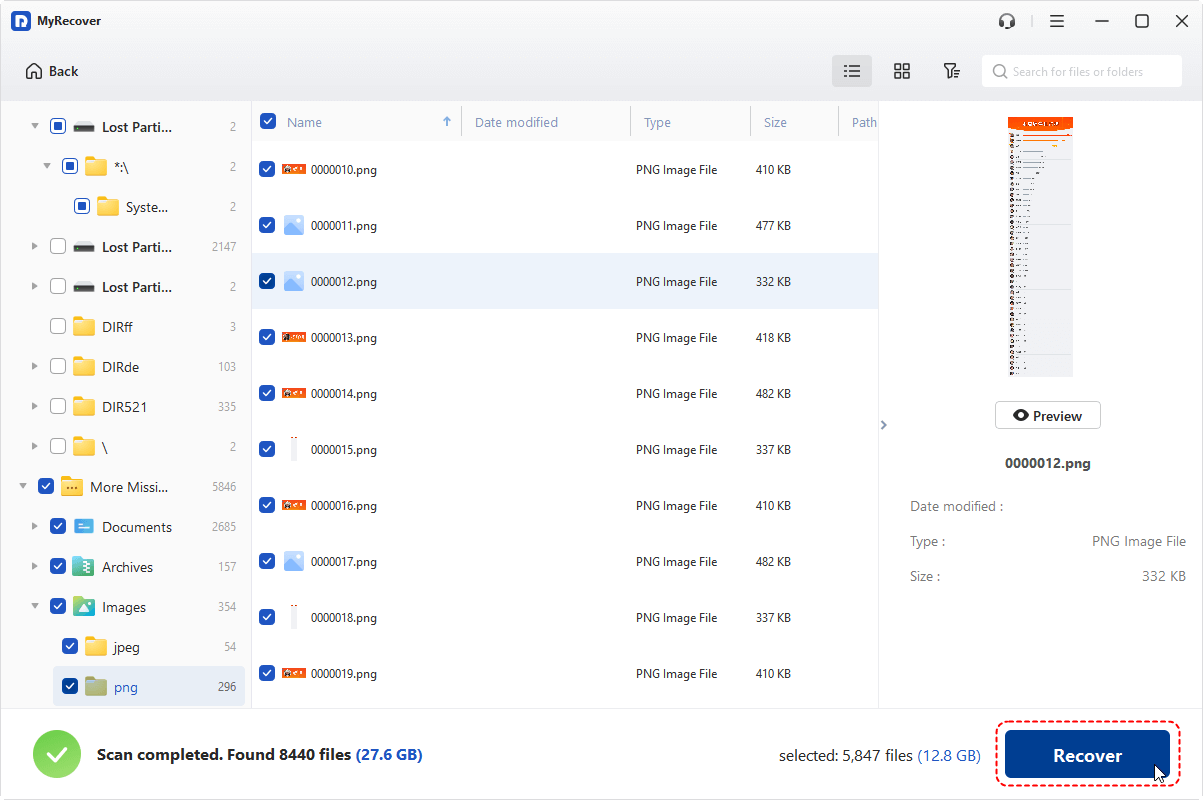
Step 3. After the scanning process, you will see all the lost files in the deleted partition. Preview them first, tick what you need to recover, and click on "Recover".
Step 4. Now choose a different drive folder to save the recovered data from the deleted partition.

Now, just wait for the process to complete, and how long it will take depends on how much data you are recovering from the deleted volume. When it is completed, you will be informed that "xx files have been recovered successfully", along with the new storage path.
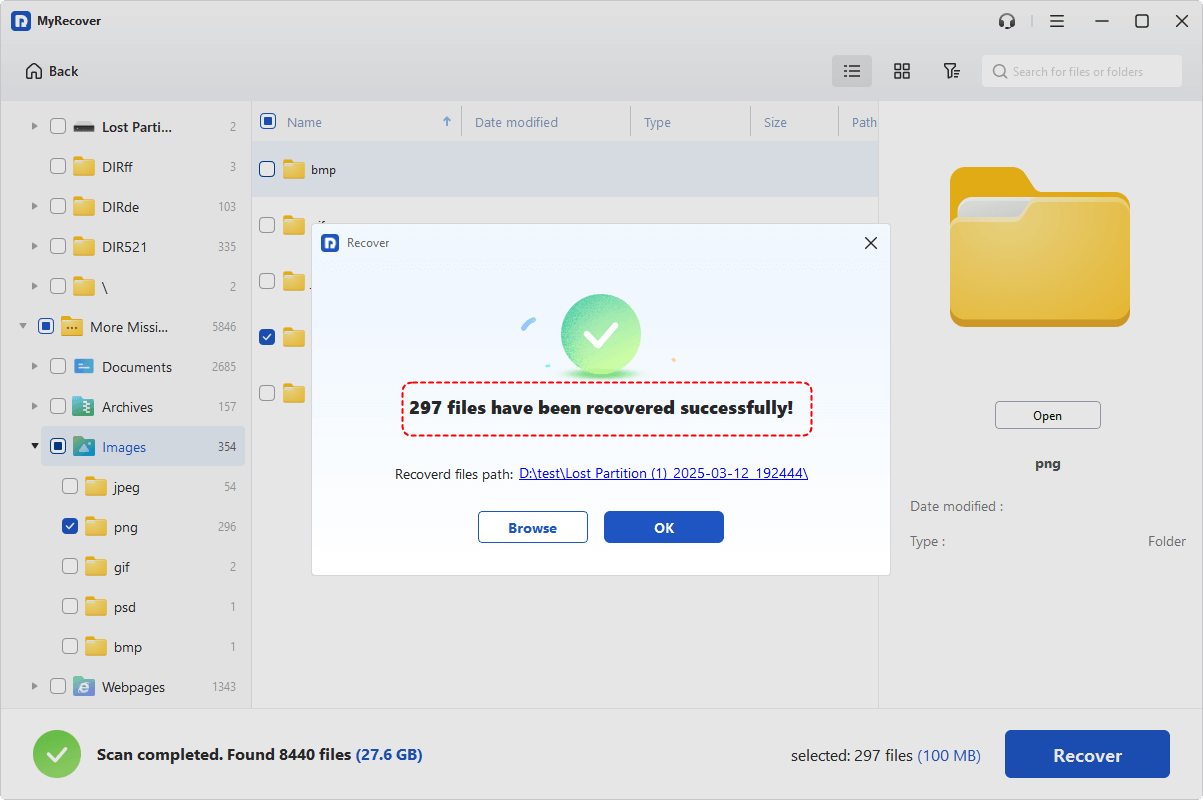
- Notes:✎...
- Save to a different drive. Recovering files back onto the same disk can overwrite the very data you're rescuing.
- Act fast on SSDs. Deep Scan improves results but cannot defeat TRIM on an SSD (see above).
- Free-tier limit. The free edition recovers up to 500MB; larger jobs require an upgrade. You can preview everything before paying, so confirm your files are there first.
- Don't keep using the source disk for everyday work until recovery is done.
 MyRecover
- Recover Deleted Files Easily with Simple Clicks
- 1000+ File Formats Supported
- Support HDD, SSD, External Hard Drive, USB Drive, SD Card, etc./li>
- Quickly Find Files Using File Types, Name, Size, etc.
- Preview Files Before Recovering
- Recover Unlimited Data
 100% Secure
What to Do After Data Recovery
Once your files are safely saved to a healthy drive:
- Back up first. Copy the recovered data to a second location (cloud or external disk) before doing anything else.
- Recreate the partition. In Disk Management, right-click the unallocated space →New Simple Volume, and choose a file system (NTFS for most Windows users). When it's done, the deleted partition will reappear in File Explorer, and you can move all recovered data to it again.
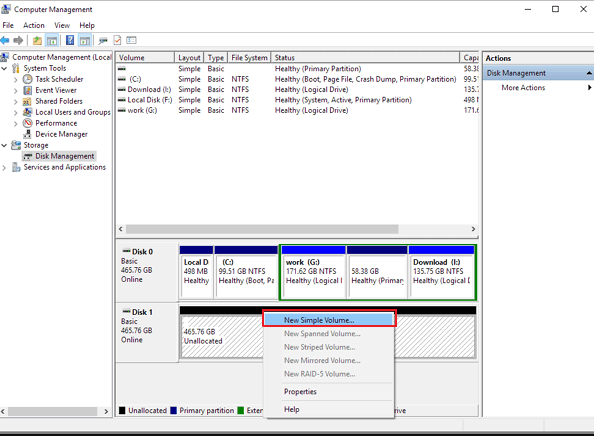
- Move your data back onto the rebuilt partition, then verify it opens correctly.
- Prevent recurrence: keep regular backups (File History, or cloud) and double-check the target disk before deleting volumes.
Recover Deleted Partition and Its Files Simultaneously | 2 Ways
There are two ways to recover deleted partitions and their files simultaneously. An intuitive interface in the Windows data recovery software, MyRecover, and the other is an open-source, command-line tool, TestDisk.
Way 1. Recover Deleted Partitions and Their Files Simultaneously via MyRecover
If you deleted the partition by accident, you can use MyRecover to recover the partition and all the files on it fast. Here is how to do it:
1. Open MyRecover, choose Partition Recovery from the left side.
2. Select a disk from the list that contains the deleted partition and click Next.
3. Choose Fast Search or Full Search, and press Next to continue.
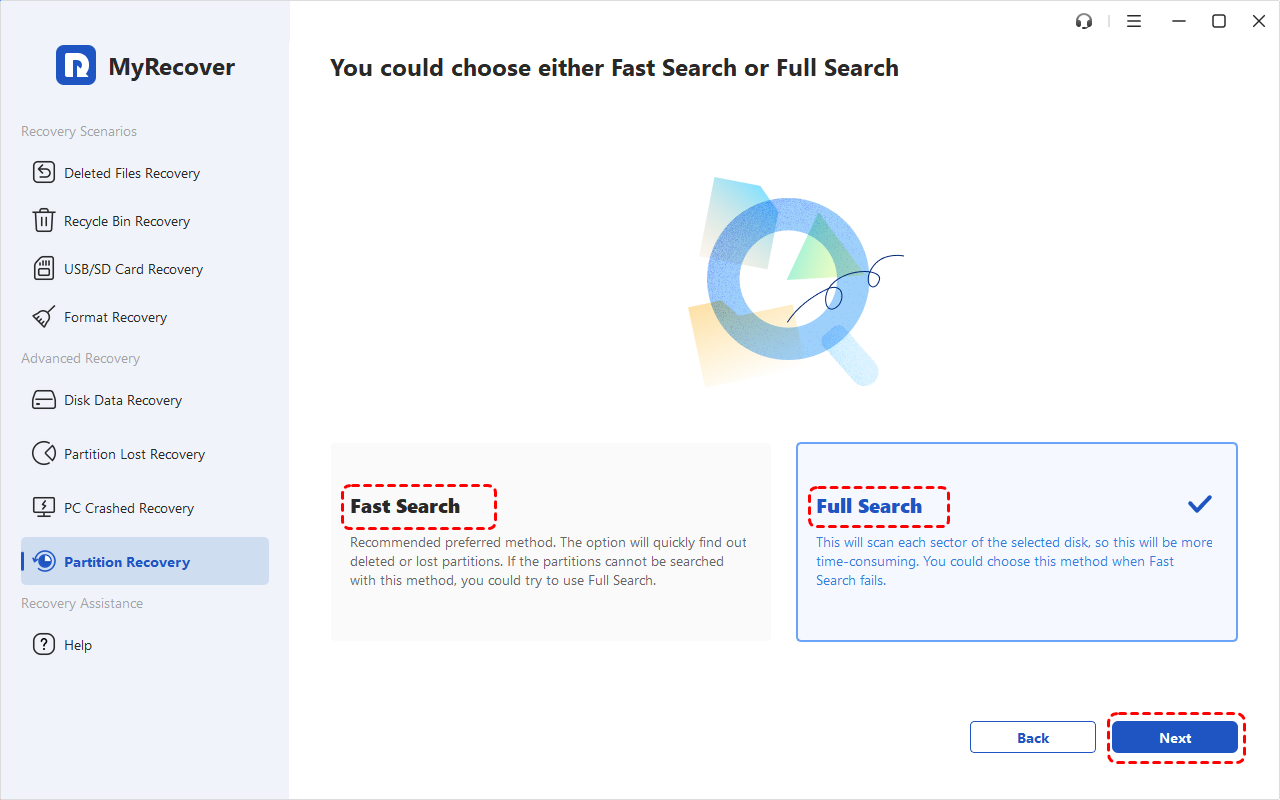
4. Tick the partition it found, then click Proceed to start recovering the deleted partition and the files simultaneously.
5. It will show you the partition recovery result. Then check your hard drive for the partition and files. All your partitions and files will be recovered successfully.
- Notes:✎...
- Full Search takes much more time if you choose this mode. It will find more missing files to recover because it scans sector by sector.
- Fast Search finds your recently deleted files and partitions. Choose based on your needs.
Way 2. Recover Deleted Partition via TestDisk (free, open source, command-line)
When you want the entire partition—with its original folder structure and drive letter—restored, not just extracted files. TestDisk reconstructs the partition table itself.
1. Download TestDisk from CGSecurity (free, open source) on a healthy computer and extract the folder.
2. Run testdisk_win.exe as Administrator. Choose whether to create a log file (recommended: Create).
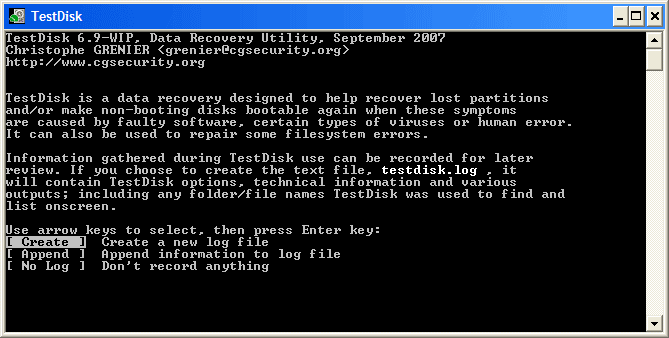
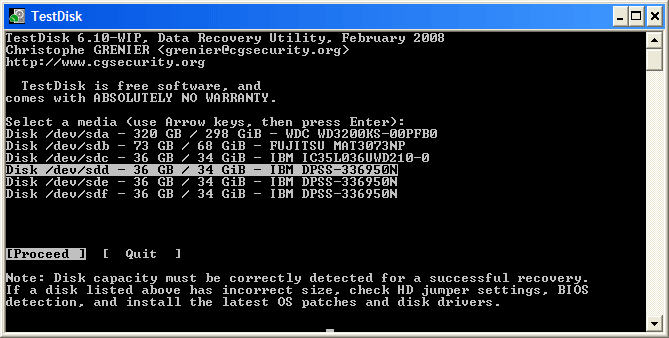
3. Select the physical disk that contained the deleted partition (use the arrow keys, then Proceed).
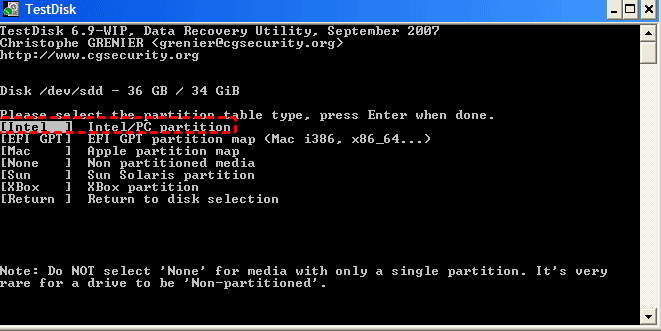
4. Choose the partition table type: Intel for an MBR disk, EFI GPT for a GPT disk.
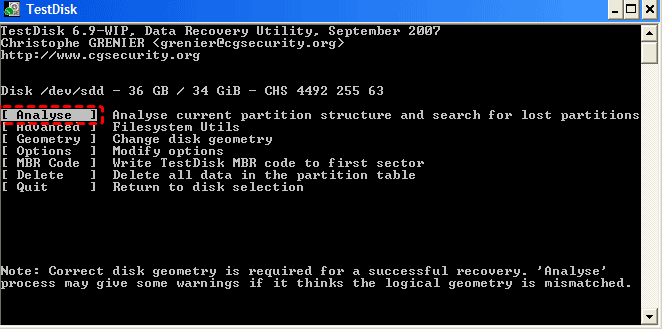
5. Choose "Analyse" → "Quick Search." TestDisk scans for lost partitions by reading boot records.
6. Review found partitions. If your partition appears, set it as Primary (P) or * as appropriate. If not found, run Deeper Search.
7. Press Enter to continue, then choose Write to write the restored partition table back to the disk.
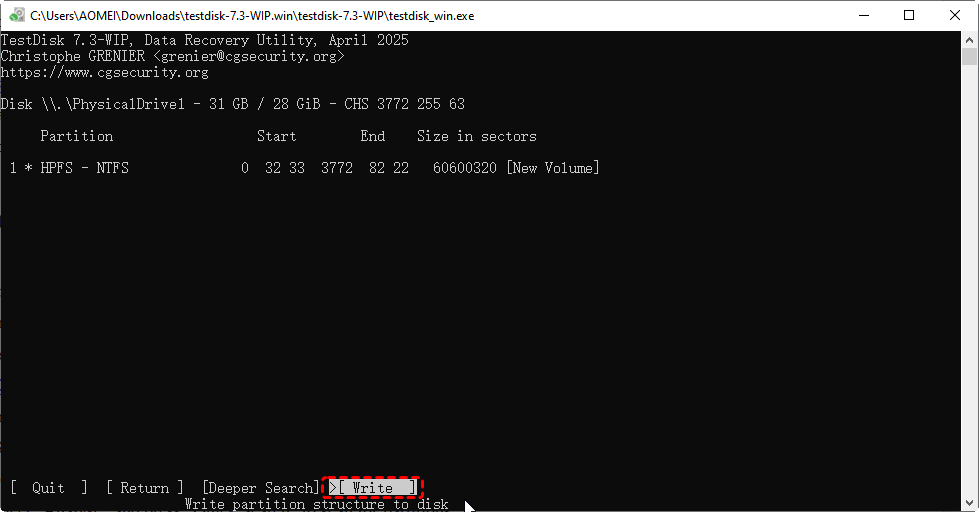
8. Reboot (or re-plug the drive). The partition should reappear in File Explorer with its data intact.
- Notes:✎...
- Preview before you write. "Reserve"/ "Write" only the partition you recognize; saving the wrong one risks further corruption.
- Prefer "copy files out" over "save table" if you're unsure—it's non-destructive and avoids altering the disk structure.
- TestDisk is command-line. Read each prompt carefully; wrong choices won't damage data, but they waste time.
- TestDisk also bundles PhotoRec for file-signature recovery if it can't rebuild the partition table.
FAQs About Recovering Data from Deleted Partition
Can I recover data from a deleted partition?
In most cases, yes. Deleting a partition only removes its entry from the partition table; the actual files remain on the disk until they are overwritten by new data. Stop using the disk immediately and scan it with a recovery tool to get the best chance of success.
How do I recover a deleted partition using CMD?
Native Windows commands such as diskpart can only list disks and volumes; they cannot reconstruct a deleted partition or restore its files. For real recovery, use a dedicated tool like TestDisk (free, open source) or MyRecover. Avoid creating new volumes in diskpart, as that overwrites the unallocated space.
Does Windows 10/11 have a built-in partition recovery tool?
No. Windows does not include a utility that recovers a deleted partition or the data inside it. Disk Management can only create a new volume on the unallocated space, which would overwrite your lost data. Use third-party recovery software instead.
Can I recover a deleted partition for free?
Yes. TestDisk is a completely free, open-source tool that can rebuild a lost partition table. MyRecover also offers a free tier with a recovery limit.
Why is SSD data harder to recover than HDD?
SSDs use a feature called TRIM that tells the controller to erase freed blocks soon after a partition is deleted. Once TRIM runs, the data is typically unrecoverable. HDDs do not have TRIM, so deleted-partition recovery on a hard drive is usually far more successful if you act quickly.
What should I do immediately after deleting a partition?
Stop using the affected disk at once. Do not create a new volume, do not format, and do not install recovery software onto that disk. Connect the drive to another computer if possible, and save any recovered files to a different, healthy drive.
Will recovering files keep their original names and folders?
File-level recovery tools such as MyRecover can often restore original filenames and folder structure when the file system metadata is intact. If the partition was heavily damaged or TRIMmed, some files may be recovered without names (raw recovery by type). Partition-rebuild tools like TestDisk restore the whole structure, including names.
How long does deleted-partition recovery take?
A quick scan usually finishes in minutes. A deep scan of a large drive (1TB+) can take 30 minutes to a few hours depending on drive speed, capacity, and damage level. Previewing results does not require waiting for the full scan to finish
The End
A deleted partition is scary, but it is rarely the end of your data. The single most important action is to stop writing to the disk, then choose the method that fits you: MyRecover for a guided, previewable file recovery (including the C: drive via bootable WinPE media), or free tools like TestDisk to rebuild the entire partition. The same principles also apply to formatted or corrupted volumes—just move faster, and always verify your files on a healthy drive before trusting the disk again.

Stay Updated With Our
Latest Tips
Add us as a preferred source on Google to never miss helpful guides.
 Add as preferred source >>